
Automation Chaos? Why a Unified Warehouse Control System Is the Missing Piece in Your Fulfilment Puzzle
If you have heavily invested in fulfillment automation, including conveyors, AS/RS systems, sorters, and AGVs, you are already ahead of the curve. But automation alone does not guarantee efficiency. Many manufacturers and high-volume fulfillment operations still face delays, inventory mismatches and overworked systems.
In fact, a McKinsey report revealed that nearly 75% of supply chain leaders still face visibility issues despite deploying advanced technologies. Why? Because those technologies don’t speak the same language.
Enter the warehouse control system (WCS), the digital orchestrator that brings harmony to your automation-heavy operations. A WCS unifies your fulfillment technology stack, allowing you to regain control and scale confidently.
What Is a Warehouse Control System (WCS) – and Why You Need One Now
A warehouse control system is the real-time operations hub that directs and synchronizes your automated equipment. It sits between your warehouse management system (WMS) and physical automation, acting as the command center for everything from conveyors to sorters.
WCS vs WMS: Clearing Up the Confusion
This is one of the most misunderstood areas in warehouse tech. While a WMS handles inventory, orders, and workflow planning, a WCS executes those plans on the warehouse floor by directing your automation systems in real time.
Think of it like this:
- WMS = Strategist
- WCS = Field Commander
For businesses aiming for unified warehouse system scalability, having both is non-negotiable.
Key Components of a Modern WCS
- Real-time machine communication: Ensure seamless instruction flow to every device.
- Equipment coordination: Align sorters, pick stations, AGVs, etc., for smooth movement.
- Data synchronization: Keep inventory, location, and equipment data in sync.
- System health monitoring: Detect issues before they become fulfillment failures.
The Hidden Costs of Disjointed Fulfillment Automation
You may not realize the full impact of a disconnected tech stack until delays start stacking up and margins start shrinking.
1. Bottlenecks and Backlogs from Poor System Coordination
When automation components don’t work together, machine idling, manual overrides, and fulfillment lags become daily frustrations. And these inefficiencies cost real money.
2. Equipment Downtime and Overload
Without a WCS to manage loads, machines face inconsistent usage, either overworked or underutilized, leading to unplanned downtime and expensive repairs.
3. Missed SLAs and Declining Customer Satisfaction
Lag in routing decisions or misfiring automation systems can result in missed shipments, late deliveries, and unhappy customers, especially when split-second speed matters.
4. Siloed Data Across Systems
With no unified view, teams rely on conflicting dashboards, fragmented metrics, and slow manual reporting. Visibility gaps can snowball into bigger fulfillment issues.
Unified Control = Unified Success: How an Integrated WCS Boosts Your Fulfillment Game
A powerful fulfillment automation control system doesn’t just tie your tech together. It elevates every part of your warehouse operation.
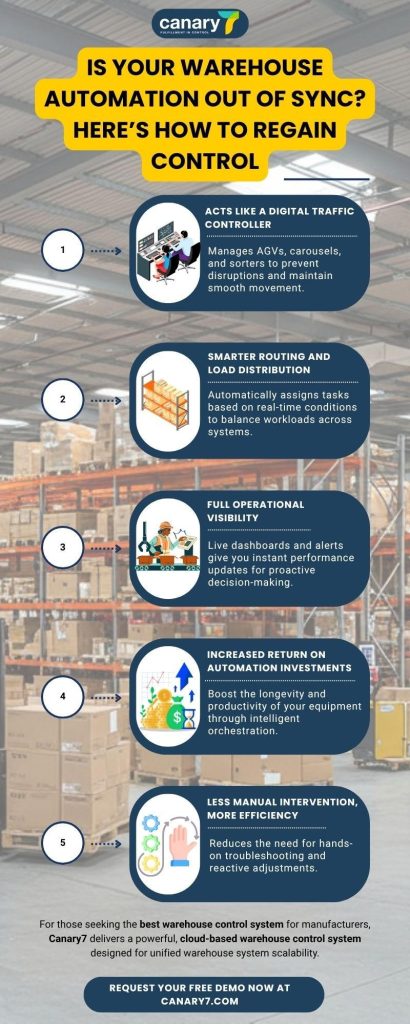
1. Real-Time Traffic Cop for All Automation Systems
Your WCS acts like a smart intersection manager, orchestrating movements between AGVs, carousels, pick modules, and more to avoid collisions and confusion.
2. Smart Routing + Load Balancing
Assign the right tasks to the right equipment based on real-time conditions. Dynamic load distribution keeps things flowing smoothly.
3. End-to-End Visibility & Performance Tracking
Integrated dashboards and alerts help you act on anomalies immediately, not after they’ve become problems.
4. Higher Equipment ROI
Maximize the life and throughput of every automated component. Get the most from your expensive investments.
5. Fewer Manual Interventions
The fewer times staff need to intervene, the smoother (and cheaper) your operation becomes.
Fulfillment Harmony – How WCS Powers Scalable, Integrated Automation
A well-integrated WCS is the difference between simply automating and orchestrating a smart, scalable warehouse.
Seamless WCS Integration for Fulfillment
You don’t need to rip and replace your current systems. A good WCS complements and integrates with existing WMS or ERP tools, bringing all your warehouse tech under one digital roof.
Central Command: Managing AGVs, AS/RS, and More from One Dashboard
Imagine a single, graphical interface where you monitor machine status, direct workflows, and resolve issues on the fly, all in real time.
Cloud-Based WCS: Remote Access, Infinite Scale
Modern cloud-based warehouse control systems provide unmatched flexibility and scalability. You gain access from anywhere & enjoy smoother updates that can benefit from future proof infrastructure which scales with your needs.
Conclusion: Unify, Optimise, and Scale — Your Fulfillment Can’t Wait
Disjointed automation leads to missed orders, wasted resources, and frustrated teams. A unified warehouse control system is the key to eliminating chaos and unlocking the true potential of your automated facility.
Looking for the best warehouse control system for manufacturers?
Canary7 offers a powerful, cloud-based WCS that integrates effortlessly with your existing systems and brings unmatched visibility, control, and performance to your warehouse operations.
Request your free demo today and experience the difference a unified fulfillment ecosystem can make.
FAQs
Q1. How is a WCS different from a WMS or WES?
A WMS handles planning, inventory, and orders. A WCS executes tasks on the floor. A WES combines some elements of both but often lacks the deep floor-level control a dedicated WCS offers.
Q2. Is a WCS worth it for smaller fulfillment operations?
Yes, especially if you’re scaling. A WCS brings efficiency, reduces manual work, and extends the value of automation even for smaller teams.
Q3. What KPIs improve after WCS integration for fulfillment?
Expect improved order accuracy, reduced downtime, faster throughput, better equipment utilization, and greater SLA adherence.
See Canary7 Running In Your Warehouse

A Demo Built Around Your Warehouse
.svg)
